Finance-Focused Rebrand Marks Structural Shift at Beijing’s Hong Kong Office
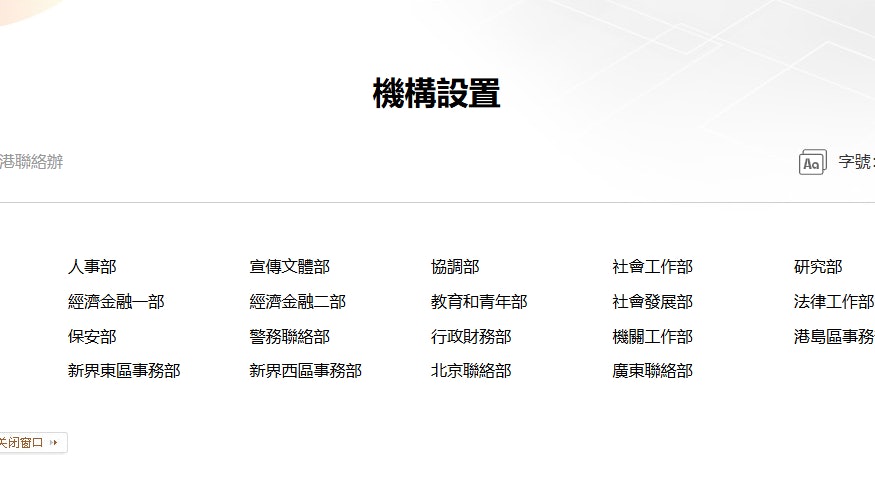
China’s Central Government Liaison Office in Hong Kong has carried out a broad restructuring of its internal architecture, renaming and splitting key departments and creating new units in a move analysts say underlines a sharper focus on finance, youth policy and district-level work. The updated organization chart, published on the office’s website, shows the traditional economic, education and regional liaison arms recast into a more granular structure, while a new Social Development Department has been added.
Under the revamp, the former Economic Department has been expanded and renamed the Economic and Financial Department, now divided into Economic and Financial Department I and II. The previous Education Technology Department and Youth Work Department have been merged into a single Education and Youth Department, reflecting an effort to combine policy oversight over schools and younger residents. The Legal Department has been retitled the Legal Work Department, while the Social Work Department has been rebranded as the Social Development Department, with observers suggesting the new label points to a stronger emphasis on engagement with different sectors of Hong Kong society and support for charitable and public-interest initiatives.
The reshuffle also reconfigures how the liaison office manages relations across Hong Kong’s districts. The former Hong Kong Island and Kowloon Work Departments are now the Hong Kong Island District Affairs Department and Kowloon District Affairs Department. The New Territories Liaison Department has been split into New Territories East District Affairs Department and New Territories West District Affairs Department, providing more tailored coverage of the city’s outlying areas. Separately, the Shenzhen Liaison Department has been removed from the structure and is understood to have been folded into the Guangdong Liaison Department, while an additional Social Development Department has been listed among the office’s units. After the adjustments, the liaison office now comprises 23 departments.
Lau Siu-kai, a consultant at the Chinese Association of Hong Kong and Macau Studies, said the restructuring reflects a recalibration of the central authorities’ work priorities in the city, aligning the liaison office more closely with the Hong Kong government’s current policy agenda. He said the greater focus on financial affairs dovetails with efforts to advance the international use of the renminbi through Hong Kong’s markets, while the consolidation of education and youth portfolios is aimed at improving education quality and job opportunities for younger residents. Lau added that the new Social Development Department may be designed to deepen links with different social sectors and encourage state-owned and mainland-funded enterprises to play a more active role in philanthropy and public welfare locally. Local media, citing unnamed sources, have reported that the overhaul is also intended to better support the chief executive and the Hong Kong Special Administrative Region government in “law-based” governance, raising administrative standards, addressing livelihood issues and maintaining social stability.